Mechanical design · 3-D beam theory · live solver
A beam solver that shows its work.
Analyse one straight member loaded in any direction, from bending and warping torsion to buckling, vibration, plastic collapse and fatigue. Every answer comes with a step-by-step worked solution and an independent check that it is right.
Free for learning and practice. Runs in your browser, with no sign-up and nothing to install.
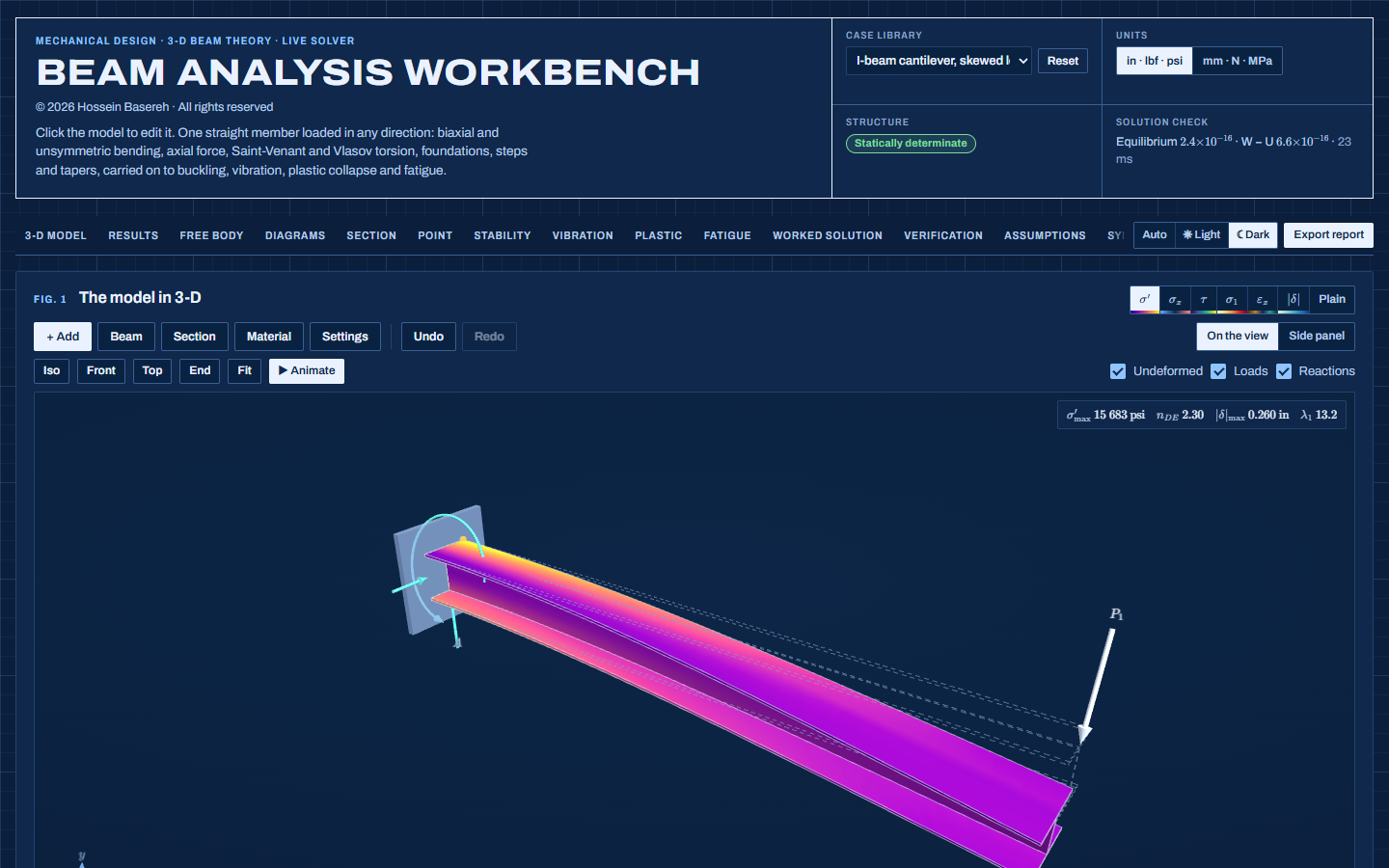
What it solves
One member, analysed all the way through
Every edit re-solves the beam with a stiffness method that includes warping torsion, then carries on to stability, vibration, plastic collapse and fatigue, all live.
Any supports and loads
Fixed, pinned, roller, guided, ball-joint and spring supports, releases and internal hinges. Point loads, couples, torques, distributed loads, attached weights and temperature changes.
Biaxial bending and axial load
Symmetric and unsymmetric sections, with exact normal and shear stresses at every point.
Saint-Venant and Vlasov
Warping torsion of open sections, with the bimoment and the warping stress Bω/Cw.
Foundations, steps and tapers
Beams on elastic foundations, and stepped or tapered members.
Buckling
Lateral-torsional buckling modes with load factors and 3-D animations, and a check that no mode is missed.
Vibration
Natural frequencies and mode shapes, including attached weights.
Plastic collapse
The collapse load factor, bounded from above and below so you know it is exact.
Fatigue
Shigley fatigue: Marin factors, the Goodman criterion, factors of safety and life.
Read every result
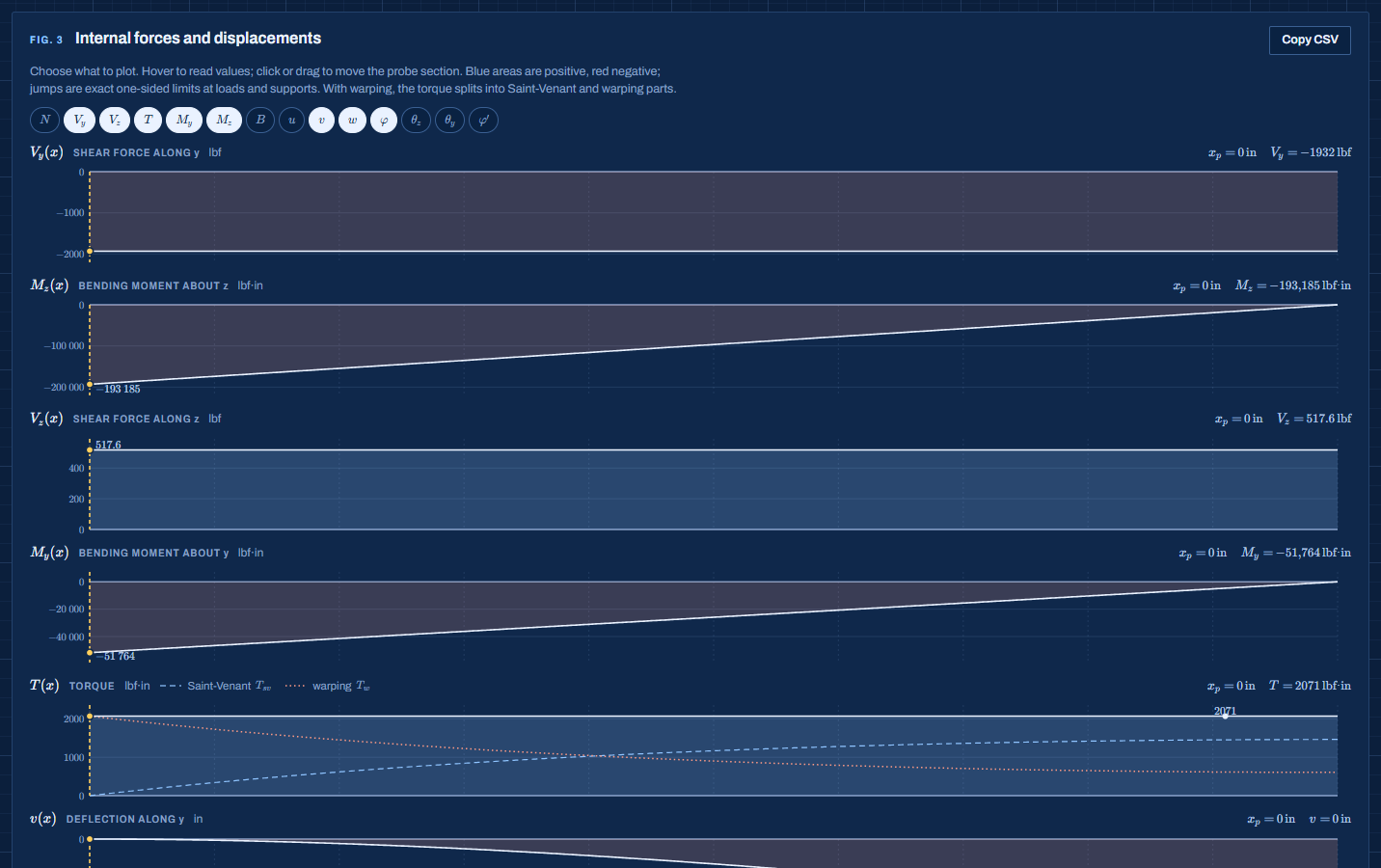
Diagrams, stresses and a probe you can drag
Free-body diagrams in each plane, then every internal force and displacement: N, V, T split into its Saint-Venant and warping parts, M, the bimoment B, deflections and rotations.
- Drag the probe along the beam to read values at any section
- See the stress field and shear flow across the section
- Track critical point jumps to the worst-stressed spot
- Switch between in·lbf·psi and mm·N·MPa at any time
For learning
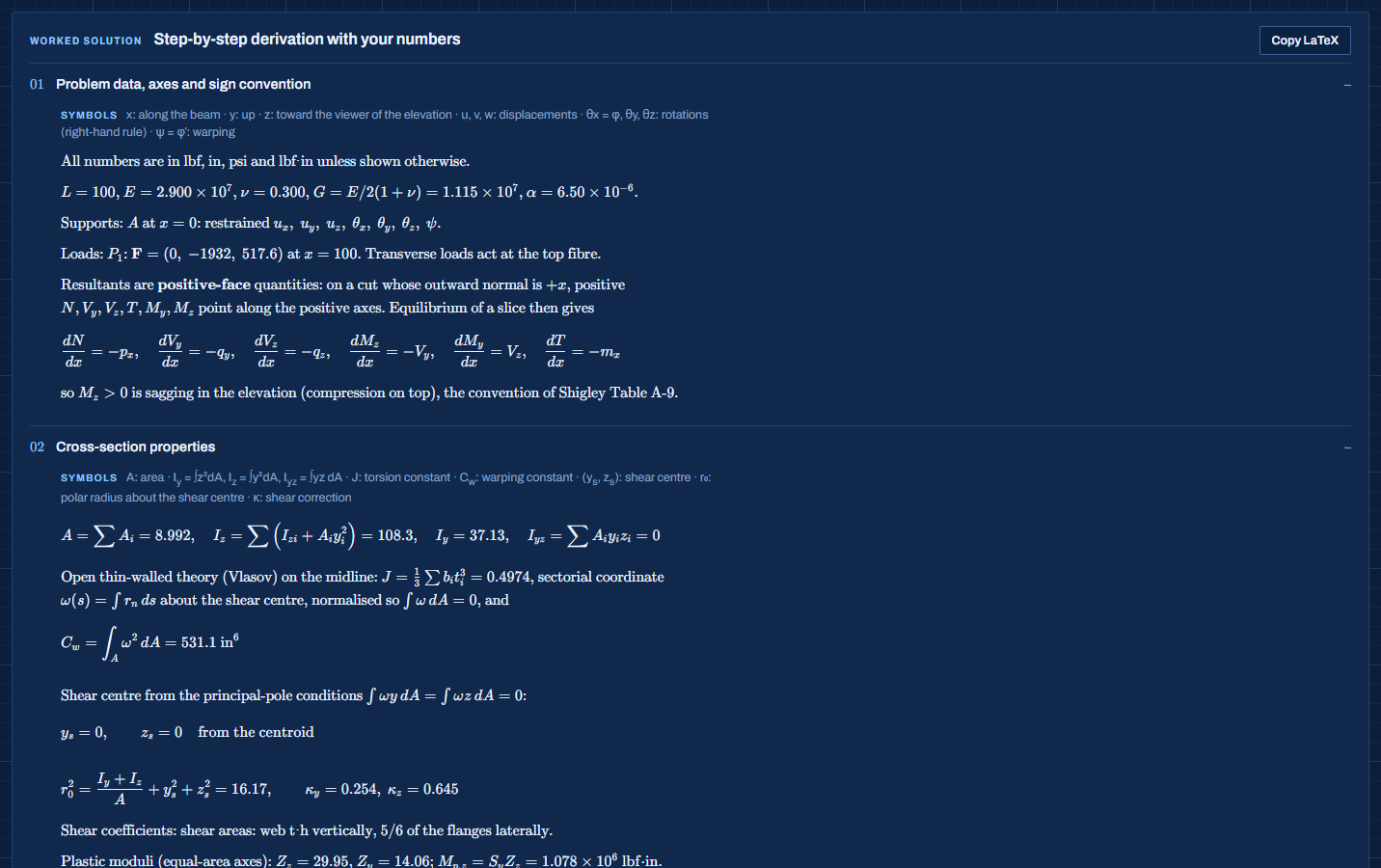
The method, not just the number
A worked solution derives every result step by step in typeset equations, using your own numbers: the problem data, section properties including the warping constant and shear centre, static determinacy, and on through each analysis.
- Follow the same steps you would write by hand
- Change the model and the derivation updates with it
- Copy LaTeX exports the whole derivation
- A case library of standard handbook beams to start from
Verification
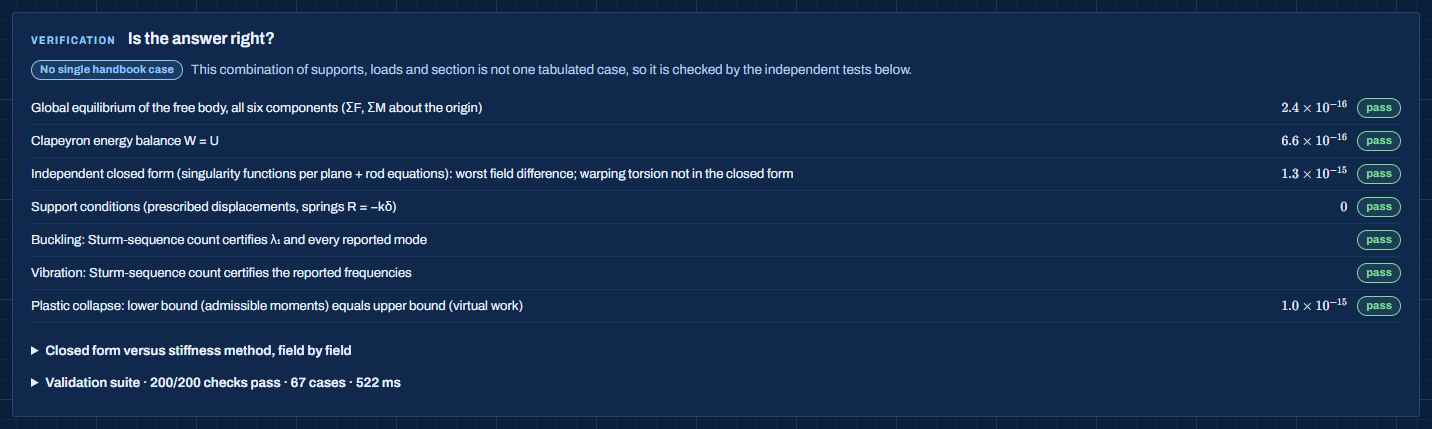
“Is the answer right?”
Each solution is checked independently, so you can trust it and see why it is right.
- Global equilibrium and the Clapeyron energy balance
- Comparison with the closed-form handbook solution
- Support conditions met exactly
- Sturm counts for buckling and vibration, so no mode is missed
- Matching lower and upper bounds for plastic collapse
Who it is for
Built for learning, teaching and practice
Check your homework the right way
Compare each step of your own solution with a full derivation, and see how the answer changes as you change the beam.
Show it, live, in class
Build a case in seconds, project the 3-D model and diagrams, and walk through the worked solution with the class.
A fast second opinion
Check a hand calculation or a larger model against an exact single-member solution, torsion and stability included.
Open the workbench
Start from a case in the library, or click the model to build your own.
Engineering disclaimer. The workbench is an analysis aid, not a substitute for professional engineering judgement. A suitably qualified engineer must check its results independently before they are used for design, construction, manufacture or any safety-related decision.